The Zen Denizens of New York City: Part 1

The Zen Denizens

(Originally written August 23,2016.)

The development of the metropolis through the ages is a topic with not only profound consequences but also causes. The dramaticism of the development at each step is the reflection of the wealth poured into the metropolis. Imagine wealth as a function on a graph. Those moments when there is a step up in a piece-wise behavior always results in something drastic. In architecture, that generally entails demolishing the existing to make room for the new. Extraordinary destruction to built anew. To take it a step almost too far would be to call this phenomenon the phoenix-like rebirth that is required for all celebrities; New York City is not so different from Madonna.

The issue of identity is never far from the populated metropolis. Identity is the most vital shield to combat the threat of obsolete and the trend of throwing out the old to make room for the new. Identity is vital to maintain one’s standing. To elevate identity to become an icon would be the ultimate method for preservation and continue acclaim.

(For the purposes of the article, let’s take New York City. They say if you can make it here, you can make it anywhere. A little footnote that isn’t mentioned is that to make it, you’ve got to fail first.)

The road to success is riddled with failed attempts, lessons learned, and necessary re-invigoration of one’s will. That re-invigoration can be and many times results from the need to change it up a bit, to reinvent yourself – to embrace those new characteristics that you’ve identified are required for your success. You must not only embrace, you must weave that into the very fiber of your being.

Enter the glossy pages full of celebrities, of the coveted lifestyle, of the coveted surroundings and identity markers to reflect this hard work.

But, that is where it gets a little difficult.

How does this reinvented self that reincarnates constantly to stay ahead of the competitive curve affect society and architecture?

As an almost contradictory juxtaposition is the nature of buildings. Buildings are meant to create shelter: space to rest and for a reprieve from nature (this extends to the concrete jungle). Buildings are the Zen Denizens. Humans upkeep the buildings against the weather elements of nature and the decay of time. But, buildings themselves? They exist because of humans. They sit and watch days melt into weeks into years and into decades, maybe even centuries. How are they to combat the destruction? Their problems  of staying current or timeless is similar for people they shelter.

The difference is the attainability of it. The cost to make the an iconic building is astronomical, and the cost to maintain the building is an additional cost that is often underestimated.

One way to maintain identity is the propagation or marketing of the identity. Which is attainable for humans through portraiture. An example would be Andy Warhol’s portraiture work that feature Marilyn Monroe and Jackie O.

By looking at how identity is preserved or propagated for people, perhaps we can gain insight on the relationship of identity and architecture. The parallelism of architectural development to portraiture is not that farfetched. Le Corbusier’s scale of man is quite timeless. Routinely, façade engineering is described as the design and engineering of the skin. By extension, the bones are structure, and mechanical, electrical, and plumbing (MEP) engineering are the organs.

One of the current exhibitions at the Whitney is about portraiture: Human Interest. The exhibition does an incredibly impressive task of looking within its collection as well as newly acquired works to construct a narrative on portraiture post WWII though the distant past where questions of representation arose to current times, where contemporary artists are now looking at that entire history and choosing to provide portraits in whichever medium and method they choose.

For more information on the exhibition, refer to the following link: http://whitney.org/Exhibitions/HumanInterest

(Please note that all images below are photographs taken of the original works as displayed in the exhibition and are intended as visual aids only. Please refer to documentation by the Whitney Museum for more information of the works.)

LOOK AT ME!
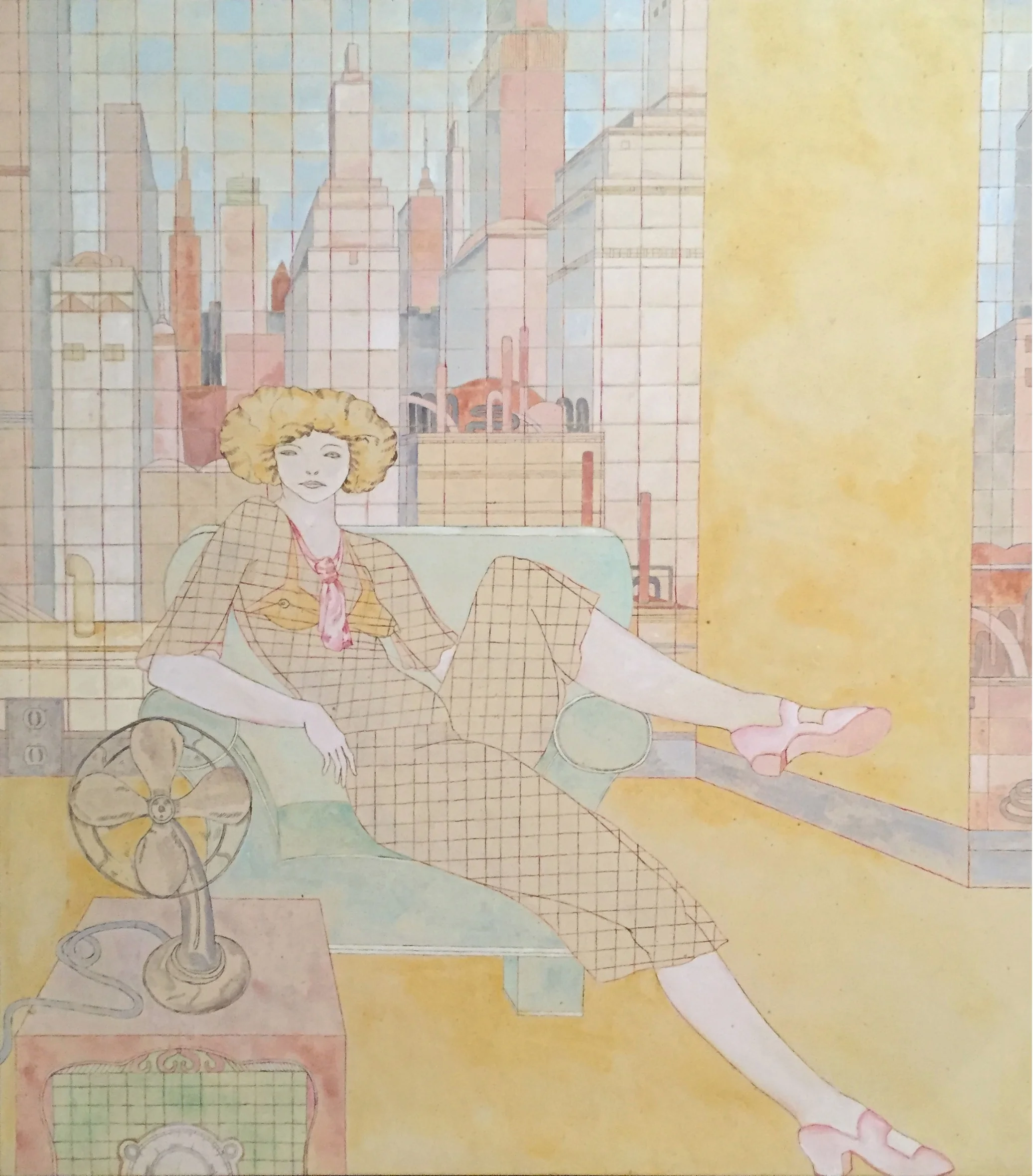
Susan Hall’s New York Portrait 1970 (acrylic and graphite pencil on canvas)

Susan Hall’s New York Portrait 1970 (acrylic and graphite pencil on canvas)

From the museum’s plaque:

The woman in New York Portrait reclines on an arm chair, her posture relaxed and sexually self-assured. The grid pattern appearing throughout the scene coupled with the transparency of her dress and the window create an ambiguous sense of space that makes it difficult to distinguish interior from exterior. Together the skyline prominently visible in the background and the title of the work present the possibility that Susan Hall meant this not as a portrait set in New York but as a portrait of the city itself, or perhaps the city as epitomized by one of its uninhibited, youthful denizens.

The plaque suggests that “Hall meant this not as a portrait set in New York but as a portrait of the city itself, or perhaps a city as epitomized by one of its uninhibited, youthful denizens.” This begs the question of if a city can be defined: by its people or its buildings. Perhaps both because they have similar needs to make identity. Visually, the composition of the female’s subject figure is juxtaposed to the rectilinear forms of the buildings at the background. Both however have similar treatment of being shrouded in the same overlaid grid.


STOP LOOKING AT ME. THERE ARE SO MANY PEOPLE HERE. WHY ARE THERE SO MANY PEOPLE.

Some flaws in the comparison ought to be pointed out. For starters, clearly, buildings are truly not humans. The sensations of pain or emotions are not appropriate to the comparison. The issue of movement and coming into contact with the same species need not apply. One portrait that provides this a visual basis for discussion point is Raphael Soyer’s Office Girls.
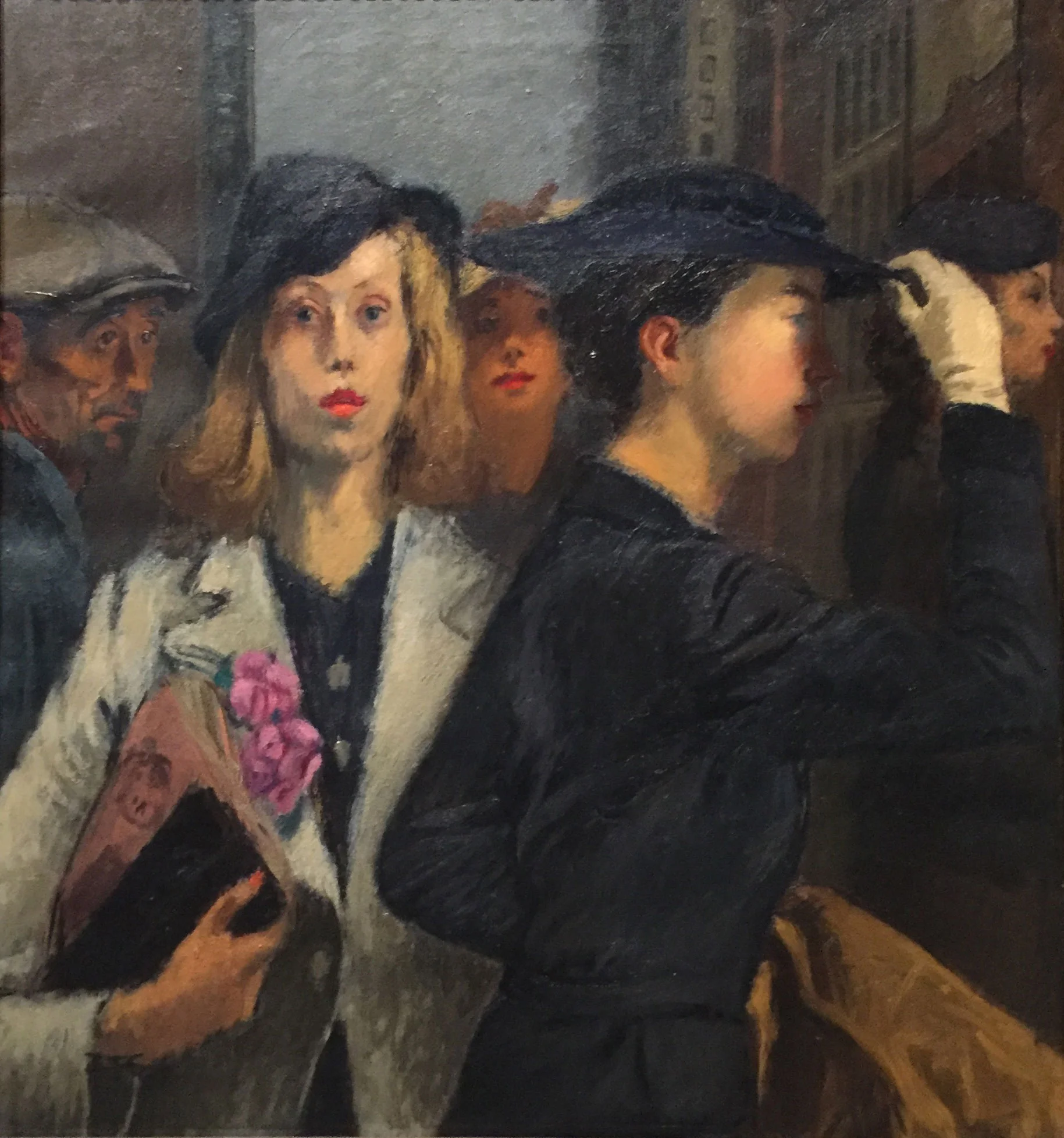
Raphael Soyer’s Office Girls 1936 (oil on canvas)

Raphael Soyer’s Office Girls 1936 (oil on canvas)

From the museum’s plaque:

An astute observer of Depression-era New York, Raphael Soyer evoked the inner lives of anonymous city dwellers. His paintings frequently depict the new generation of female workers he encountered in his Union Square neighborhood. Leaving the home for secretarial and clerical jobs, these “office girls” achieved an independence that was unprecedented for the women of the period, even while unemployment remained high among men. While his artist colleagues usually portrayed these young women in optimistic terms, Soyer’s composition strikes a more ambivalent one. Squeezed between a throng of rushing female workers and a glowering man, the central woman looks out at the viewer with a gaze that is at once weary and unflinching.

Buildings are literally born with “a gaze that is at once weary and unflinching.” Once a building is complete, it begins to weather and at a certain point will become visually “weary.” As for “unflinching,” a building hardly can flinch. it can deflect under wind load, but not under glowering stares.


BET THOSE OTHER PEOPLE DON’T HAVE THIS.
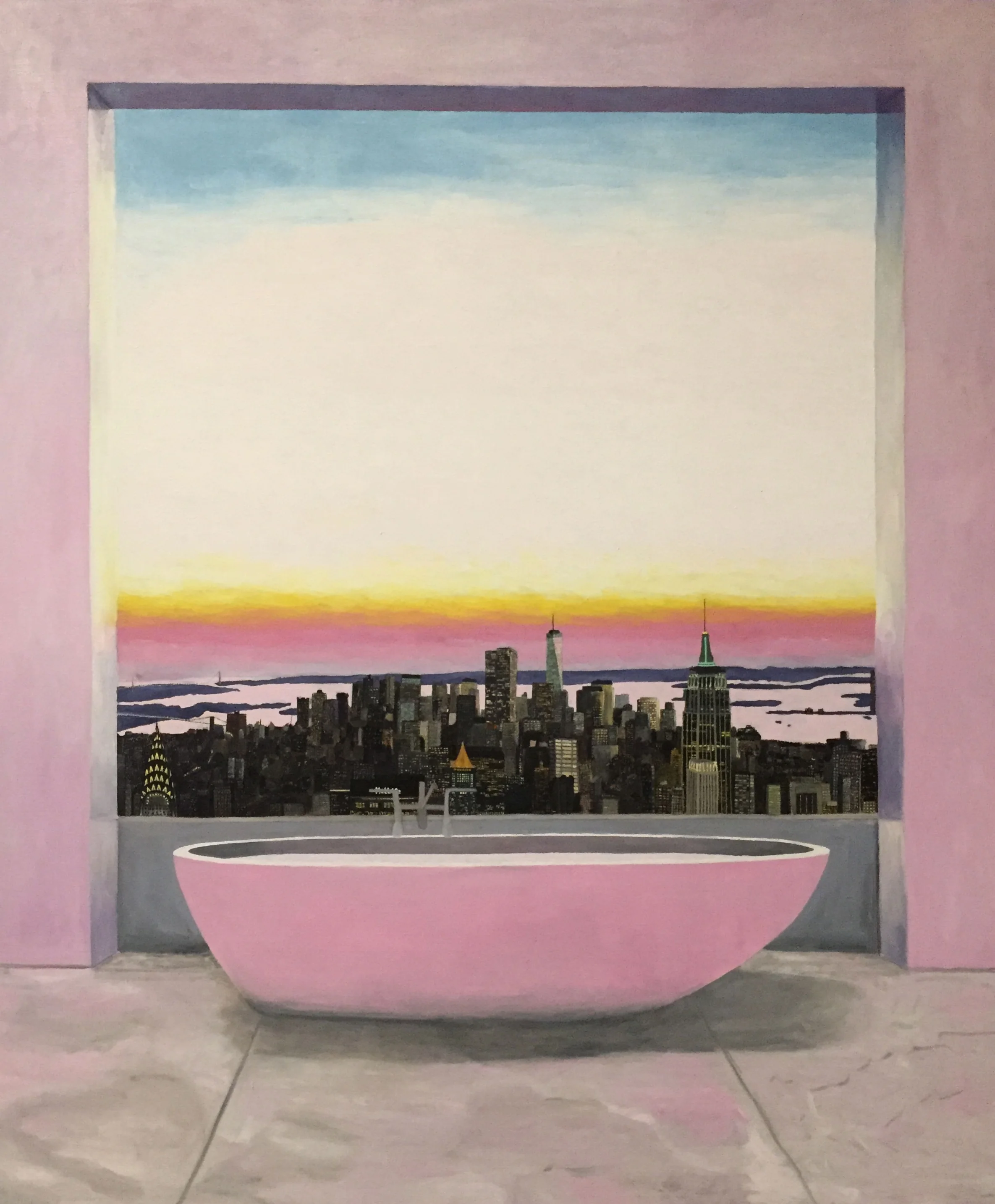
Leidy Churchman’s Tallest Residential Tower in the Western Hemisphere 2015 (Oil on linen)

Leidy Churchman’s Tallest Residential Tower in the Western Hemisphere 2015 (Oil on linen)


From the museum plaque:

This painting depicts the view from 432 Park Avenue, a 1,396-foot-high luxury condominium completed in 2015. While the tower has been heralded as a marvel of contemporary engineering, it has also sparked an outcry over its impact on New York’s skyline and the stratospheric cost of its apartments. Leidy Churchman based his canvas on a rendering he found on the developer’s website that juxtaposed a luxurious bathroom interior with the sprawling mass of lower Manhattan beyond. Churchman’s dizzying composition is at once inviting and disconcerting, hinting at the building’s controversial status as a symbol of the glaring divide between the ultra-rich and ordinary New Yorkers.

The presence of this work in an exhibition centering on portraiture further defends the comparison of architecture and people. This image defines an identity. Better or worse, if a person has this, it becomes part of their identity, in the same way that possessions can define a person’s identity if they allow it. In turn, it changes how they move through society. The skyline below dwarfs in the background due to perspective and vantage point from the bathtub. It creates a juxtaposition that a singular bathtub is above the skyline. A rather petty bathroom fixture can hardly be greater than the marvels of city planning and architecture. However, it can be the perspective or vantage point through the lens created by the wealthy elite and their unattainable architecture.

This discussion also brings to light consumerism and materialism. As people, we enter and leave the world the same way, naked and without anything. Our bodies are all made of the same building blocks - cells. Each building at the end of the day generally literally have the same building blocks - concrete, steel, aluminum, glass, clay, etc. So does this materialism do anything for us during the time we are here? It is a status symbol that we cannot take with us.


WELL MAYBE I’M JUST LIKE EVERYONE ELSE. HA. MAYBE.
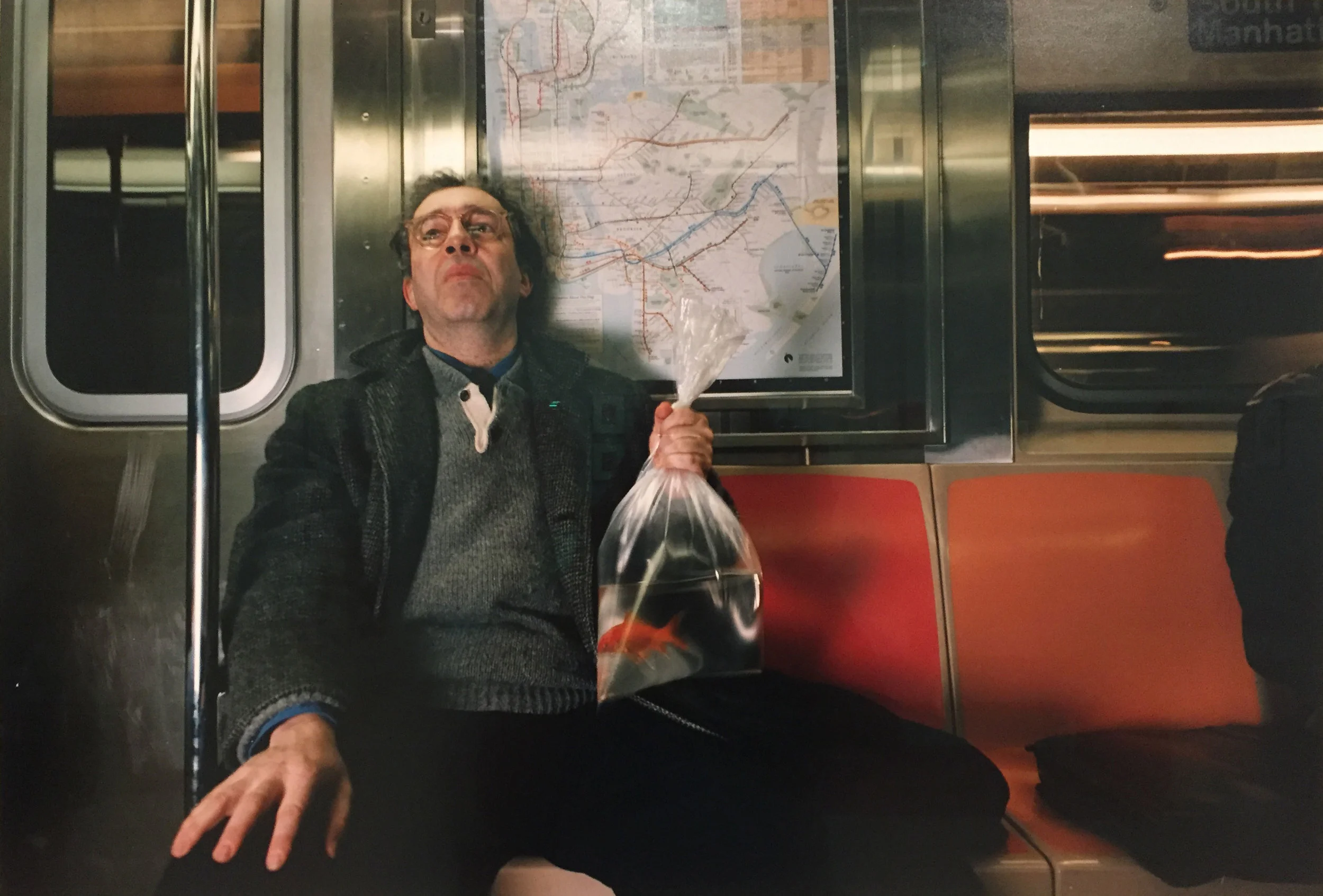
Philip-Lorca deCorcia’s Igor 1987 (Chromogenic print)

Philip-Lorca deCorcia’s Igor 1987 (Chromogenic print)

From the museum's plaque:

On first glance, Philip-Lorca diCorcia’s Igor recalls the documentary tradition of Walker Evan’s famous subway portraits (also on view in this gallery), which were shot with a hidden camera. Yet certain details of the composition – especially its gleaming, almost cinematic lighting and preternatural stillness – undermine its candid appearance. Indeed, as he often did for his photographs from this period, diCorcia carefully staged this scene and used a friend as his model, creating a fusion of realism and artifice that questions photography’s traditional role as a truth-telling medium.

The “truth-telling medium” of photography is further turned on its head in the context. Here the portrait imitates life. The same could apply to buildings; with more cost efficient materials becoming available, the easier it is to create a coveted aesthetic without using traditional costly materials.

At the end of the day or the end of an era, the death of a building or a person the first time can be kept at bay with reinvention and maintenance.

The following quotation is attributed to the artist Bansky: “I mean you die twice. One time when you stop breathing and a second time, a bit later on, when somebody says your name for the last time.”

Perhaps the materialism we explored earlier helps extend the second time. Because the first death is the great equalizer; it returns the cells and building blocks. The second death is counted by the lasting legacy or reputation.

Presidential legacies, the creation of and the reverence for, are on a lot of people’s minds. Simply look at Franklin D. Roosevelt’s legacy. There are still books published often and frequently on his life and times, such as His Final Battle: The Last Months of Franklin Roosevelt by Joseph Lelyveld, which was reviewed in the most recent issue of New York Review of Books, dated September 29, 2016, Volume LXIII, Number 14. Not only are there still comparisons and examinations of his life and times, like many influential historical individuals, there are monuments and infrastructure dedicated to his memory, such as the FDR Drive.

For architecture, let’s take a look at the original Pennsylvania Station. It is still revered to this day and the textbook example of the importance of landmark and architectural preservation. An absolute architectural and engineering marvel, the station was prematurely torn down to make way for the Madison Square Garden entertainment arena and a completely underground Pennsylvania Station.

By creating an identity first and then a legacy second, both inhabitants and architecture can fight the threat of competition and of time.


next: part ii


updates on side project #3: headphone clamp

So, it's been a while.

But! An update is in order!

I went through an intensive few weeks to do some cardboard prototypes: three different geometries and a few mechanism studies. Ultimately, I wanted to go through an exercise to better understand and appreciate the process for product development. I also wanted to try applying my engineering skills and design thinking to solve a problem on a scale that was not architectural. Plus, sometime last year my headphones were trampled. I felt indignant and did not want the same thing to happen again. (Bitter I was! Ha.) So, with my curiosity towards product design and my desire to prevent another headphone catastrophe, I set off on my side project #3. 

Below are some story boards from my in-progress portfolio to illustrate my process. Farther below include a transcript of the first page text for easier reading on mobile devices and some reflective thoughts.

"Design Problem Identified: Too often, large headphones can get damaged by getting knocked off of desks Headphones are generally preferred over earbuds for their audio quality and comfort.  However, too often, headphones are too large and can get damaged by get knocked over on desks.
As the work environment becomes more flexible, professionals are moving more often to spaces that are redefining  the work space. Whether commuting between home and the office or between coffee shop to collaborative makerspace, with a laptop and a few supplies, including headphones, work can be conducted almost anywhere. 
The idea behind Deskmate is to make using headphones more mobile by providing a space for them. Clamping headphones to the side of a table prevents them from being knocked over. Coiling the chord of the headphones controls the clutter of the chord, but also keeps the cord from getting caught on a passerby, whose movement can accidentally pull the head phones off the desk. 
This was a self-initialized project outside of my work as a facade engineer to begin to understand the process of product design and how to apply my technical thinking and knowledge to a new problem for a different target audience. This project also gave me a new appreciation for articles from design journals and publications that explore the process of interactive product design and development in general."

My previous post and survey (click here for more) was a call for folks to complete the survey above. The positive correlation, between folks who use headphones in a work environment and those who move their headphones often, helped bolster my idea in a small way that the problem I was designing for myself could benefit other people.

I also tried using the amazon sweepstakes option to incentivize my survey. My giveaway was a tea diffuser chosen to be given away at survey participant number 25 as that was the number of participants I had hoped for. By sharing on facebook and asking friends and family to spread the word, I received more than 60 responses.

All in all, it was a refreshing change in perspective. And, I learned quite a bit about self-discipline and how resourcefulness can stretch time and materials.

a retrospective view: the night thoreau spent in jail

summary: monetary contributions in the arts are incredibly important.  receiving donations has been kinda hard to do for any artist.  it shouldn't be.  receiving creative/collaborative/technical help shouldn't undermine anyone either.  also, donuts.

When I was attending university, I had an incredibly formative experience as art director of the spring of 2011 CUPlayers The Night Thoreau Spent in Jail.  I have to be honest, it was not shear luck that I got that role, or was it?

I always had a thing for the Transcendentalists, even after I came to realize that they really lived quite cushy lives despite their emphasis on living beyond the material.  It is this conflict exactly that is explored in The Night Thoreau Spent in Jail, and more recently, The Art of Asking: How I Learned to Stop Worrying and Let People Help by Amanda Palmer.  In her book she urges folks who create to accept help openly.  In Thoreau's case, living "solely" on the land at Walden was exactly as Romantic as you'd think it would be.  So, his mother and sister would arrive once a week with a basket full of baked goods -- including DONUTS.  

As explored in Amanda Palmer's TEDtalk and her interview on brainpickings, we're in a society that serves up harsh criticism to those who take the metaphorical donuts, especially for solo artists and support in cost of living.  There is a perception that if you accept help, you're somehow not as dedicated to creating as the next person or that your work isn't worthy of praise, because hello -- you had help along the way.  That person is a conceptual artist working three jobs to pay rent on the studio and has been living on PB&J -- What do you mean it's too hard?  Why would you accept your old aunt's help on the rent?  You would even ask?!

It's not too strange now to see "Donate Here" links on sites; some of the ones I frequent most do.  It's that sweet spot where someone is creating and working but doesn't have corporate sponsors because of the obligation and the adverts that come with them, because well that wouldn't be true to the spirit of the project.  I think of architecture studios that are three people strong and are doing work for fees, but the ends aren't meeting.  Wouldn't it still be weird though to see a "Support Us" button on their website?  

But, what about the master buildings of yesteryear -- Brunelleschi and Medici, Picasso and his entire entourage?  They had help along the way that wasn't exactly buying supplies such as paint or a work of art like a painting.  Their patronage happened to be in money, liquid capital -- the total amount of which we'll never really know.  However, must patronage be so grandiose?  

Can't help be in a form other than money or supplies or anything physical?

This bring me back to my earlier point about getting involved with The Night Thoreau Spent in Jail.  It was luck that brought me and Cody Haefner together to live a few doors down from each other in our first year dorm.  Cody would be the director and leader of the whole The Night Thoreau Spent in Jail  project.  I'd spent my high school art thesis project on making cakes out of inedible materials (more on that at a later date).  Cody had participated in theater all throughout high school.  He came ready to get involved first day at school.  We hit it off as friends, and he had the brilliant idea of getting me involved in theater so we could still hangout while he got more involved with the performing scene.  

We'd later talk about The Night Thoreau Spent in Jail  as I'd recommended he check it out when we both discovered our mutual interest in Henry David Thoreau.  He had heard about it before, and I'd like to think I was one of the many nudges that got the project going.  It also helped that I mentioned I wanted to do a simultaneously minimalist and dynamic set with music, lights, and moving pieces.  While this play honestly demands that sort of artistic direction, this sort of brainstorming isn't something money can promote, I don't think.  

I learned many lessons from that experience.  Namely, I was in over my head.  In hindsight, the number one thing I would have done was shape my design team that was just so green.  Inexperience isn't an issue -- I wish I had more knowledge or could direct them to folks or books that could help them out.   I wonder how much more they could have brought to our weekly design meetings if they knew their disciplines better -- if I knew their disciplines better. I just didn't realize we needed help, because my lighting designer didn't ask for it.  I had assumed (this is the problem), that her previous experience plus what seemed like a driven focus would allow her to learn the switch board in time for the production.  And, like the metaphorical donuts and fiscal help, creative help can sometimes be seen as diminishing to one's contribution or worthiness.  Maybe that is why she didn't ask?

I wonder what would have happened if I had locked myself up in a room and read a lighting manual book, swallowed the little pride I had, and then baked a dozen cookies to ask a more experienced lighting designer for help, either in training the newbie or getting pointed to books/videos.  I definitely should have gotten more involved, although it seemed impossible at the time juggling schoolwork and basic responsibilities (wearing a swimsuit in place of underwear doesn't really work after a day).  

I think having learned the lesson of anticipating what needs to be learned and what tools are required, I now train  new comers within our group at work in an anticipatory sort of way.  It's become part of my role at work.  In parallel, what previously had been schoolwork and said basic responsibilities are now replaced with calculating structure for facade support or detail curtain wall systems, etc.  I've become better at multitasking and carving out time.  It also helps when work day hours exist (which for student theater productions, and any form of art, do not exist).

The takeaway is the importance of monetary support but also the importance of collaborative support.  Cody had given me that collaborative support (and nudges to focus) that ended up teaching me so much more than just how a play works.  While I'll take donuts any day, I'd like to share it with some good company.  (Maybe we can even get more donuts!)

knowledge enables design: kat's side project #3

Can't very well design the next innovative scuba get up if you've never held your breath under water. 

I'm working on a project based on how people listen to music.  It's nothing super over arching, and it is a grain of rice of an idea right now.

I know how I listen to music, podcasts, news, etc., and how productive I can be both creatively outside and during work.  But, how do you all listen to music?  Do you do it on the go?  Do you only listen to podcasts and only in one place?

I'd love to know.  Please help me better understand by filling out the survey via the link below.  There's even a chance to win a small gift!  Share the link too!

http://goo.gl/forms/qPScd5gwkx

the importance of being earnest

I'd like this page to be an online notebook for me to keep track of my online info mining, image searching, and the drafting table for my connections I make from sources physical and virtual.  My insights bloom out of my engineering background, architectural interest, and artistic bent (as I've been told).  And, I want it to keep me earnest.

Lately, I've been reading quite a bit of what good design entails.  Not only just: What is good design?  But, also: what are the steps one has to take?

There are some preconceived ideas I've had before I started on this pursuit of reading essays and interviews by folks I admire.  Below are those ideas married with the recently found new ones.  They've have been recycled and sown together many a time by other folks and with different anecdotes.  I've put them below, and will elaborate on those ideas with personal anecdotes and examples in future posts.

Some ideas:

  1. Good design is in the pursuit of truth
  2. Good design is integrated with process
  3. Good design is invisible
  4. Good design is art (art needn't been good design, although it can be.)

The pursuit of truth is the guiding light to good design.  When you're confronted with a disgruntled user or cannot connect two pieces together, you've got to ask what is missing?  What is there?  And, to be brutally genuinely honest when answering those questions -- that's the hard part and results in iterations and failures all in the pursuit of becoming invisible.  Saddle up and good design will become something that wows you and those around you -- opening up doors you never even knew existed.  (Although I can't guarantee surprise relations to rich folks like Oscar Wilde's play.) 

In addition to reading, I've also been consuming radio shows, podcasts, museums, galleries, and really anything that catches my senses.  And, I ask why?

So, what exactly have I been consuming (as of late and constantly)?

brainpickings

dezeen.com

99u's Make your Mark series

Barnes Foundation

Metropolitan Museum of Art

MoMA

Haruki Murakami's Sputnik Sweatheart